A Scenario Is a Question, Not a Forecast
A scenario is a question, not a forecast: use a plausible Southern future to test a real decision, expose fragile choices, and prepare for changing conditions.
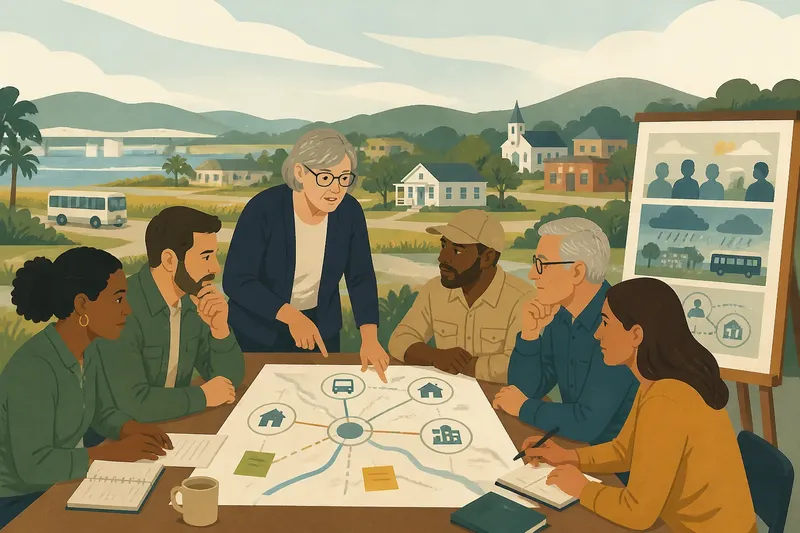
How can a Southern community tell whether a decision will still make sense if local conditions change? Scenario planning gives people a way to test a choice against a plausible future without treating that future as a prediction.
The distinction matters. A forecast estimates what is expected; a scenario traces one possible chain of conditions and consequences. Its purpose is not to build a persuasive story or reach agreement about what will happen. It is to reveal where a decision depends on a particular assumption, and what people might do if that assumption fails.
Frame a decision test
Start with a choice that someone can actually make. A regional partnership might be deciding whether to share responsibility for connecting residents with essential services. The useful question is not “What will our community look like?” but “Would this arrangement still work if residents’ schedules or travel options changed?”
Write down the options under consideration and the conditions each one depends on. A decision to coordinate referrals, for instance, may depend on organizations keeping their contact information current and having a clear way to pass requests along. Those dependencies give the scenario a job: test whether the arrangement remains workable when circumstances shift.
Say a fictional county is considering a shared referral process. Its starting inputs are a printed directory, separate intake procedures at several organizations, and a proposal to name one coordinator. The group imagines that staff availability becomes less predictable while the directory continues to list the old points of contact. It traces the effect: referrals may stall when the listed person is unavailable, so naming a coordinator alone would not address the weak link. The resulting decision is to pair the coordinator role with a process for updating contacts and routing unanswered requests. This is a worked possibility, not a claim about any actual county.
Set useful boundaries
Name the place, decision, and period the test covers. “The South” is too broad for a decision about service access. A coastal town, a rural county, and a small city have different institutions and constraints; a scenario should specify the community or connected area relevant to the choice.
Choose a time horizon that fits the decision, using ordinary language such as “over the next planning cycle” or “by the time current students make household decisions.” A near horizon may suit service coordination; a longer one may be needed for land use or infrastructure. The point is to give the test enough room to matter, not to make the future sound dramatic.
State what is outside the exercise. If the decision concerns referrals, the group does not need to invent a full account of the regional economy, culture, climate, and politics. A narrow boundary makes it easier to see which consequences could change the choice.
Track decision dependencies
Gather only the material needed to understand the current arrangement and its dependencies. A county service directory, transit route map, planning document, or written description of a referral process may help. Treat each source according to what it can establish: a route map describes a route, but does not show that every resident can use it or that it will remain unchanged.
For each option, distinguish present observations from expectations. “These organizations currently use separate intake forms” is an observation if the forms confirm it. “They will keep using them” is an assumption. Mark the assumptions that could change the decision, then ask what observable sign would indicate that one is no longer holding.
A short decision table can keep the exercise practical:
- Check whether the proposed arrangement depends on one named contact; if so, decide whether to add a backup contact or a shared routing method.
- Check whether residents need to travel to use the option; if they do, decide whether to compare it with a phone, mail, or community-based route.
- Check whether the option relies on a current directory; if contact details are not maintained, decide who will update them and how unanswered referrals will be handled.
- Check whether organizations must share information; if their procedures differ, decide whether to agree on a limited common handoff or keep referrals separate.
- Check whether the arrangement assumes residents can call during office hours; if not everyone can, decide whether another contact window or channel belongs in the design.
- Check whether the option remains useful when one partner is unavailable; if it does not, decide what temporary fallback should take over.
These checks do not require elaborate scoring. The aim is to make a choice’s dependencies visible and tie each one to an alternative, rather than letting a neatly written scenario stand in for a decision.
Trace a plausible change
Choose one condition that could matter to the decision, such as altered work schedules, changing travel access, or a different pattern of coordination among local organizations. Then trace the consequences in order: what changes first, what people would notice, and which part of the proposed arrangement would be affected?
Keep each link grounded in the decision. If schedules become less predictable, residents might find fixed office hours harder to use. That could shift more requests toward community organizations, which might then need clearer referral information. The scenario is useful because it exposes a dependency in the proposed service arrangement, not because every part of the chain is certain.
Give the scenario a neutral title and describe ordinary conditions under it. Avoid exact outcomes or claims about how all residents would respond. Details that do not affect the decision—such as the appearance of a future building—are not worth the effort unless the choice itself concerns that feature.
Compare options under pressure
Use the scenario to examine each option, not to pick the most dramatic story. Ask what would continue to work, what would become harder, and what additional information would change the decision. If one arrangement depends on a single office being reachable, while another has a fallback contact, that difference is more useful than debating which future seems most likely.
When needed, create a contrasting scenario by changing one decision-relevant condition. For example, compare less predictable schedules with a situation in which service hours become more coordinated. Then check whether the same option works in both. If it does, the choice may be less dependent on that particular assumption; if it does not, the group can identify a contingency or delay commitment until it has better information.
Record the result in decision terms: the option that appears more robust, the dependency that remains unresolved, and the signal that would prompt a review. This turns the scenario into a test of readiness rather than a contest over whose account of the future sounds most convincing.
Questions about scenario planning?
How is scenario planning different from forecasting?
Forecasting estimates an expected outcome, while scenario planning examines what could follow under a set of stated conditions. A scenario can inform a choice without claiming that its path is the one most likely to occur.
How many scenarios should a group use?
One scenario can test a particular dependency; a contrasting one can show whether an option holds under a different condition. Add another only when it changes the decision test, rather than simply adding another story.
Can a scenario include an unlikely event?
It can if the event matters to the decision and its uncertain status is explicit. If the chain requires several implausible turns, it may be a poor test of ordinary choices and should be replaced or clearly set aside as a stress case.
Who should shape the scenario?
Include the people responsible for the decision and people familiar with the local systems it could affect. Their role is to identify dependencies and consequences, not to make one account stand for every community across the South.
Keep the test usable
Save the scenario with the decision options, assumptions, observable signals, and resulting actions. If a signal appears—such as contact details repeatedly failing—the group can review the relevant dependency and decide whether to use its fallback, revise the arrangement, or gather more information. This record also makes clear why the choice was made without turning the scenario into a standing prediction.
Scenario planning is most useful when it changes how a decision is framed: a fragile assumption becomes a condition to monitor, or an option gains a practical fallback. For Southern communities, local knowledge can help identify which dependencies matter in a particular place, while careful boundaries prevent one local account from being mistaken for a regional forecast.
Keep the distinction visible in later conversations by saying “under this scenario” before discussing an imagined consequence. Then the group can challenge the condition, the chain of effects, or the proposed response separately—and keep attention on the decision that still belongs to them.