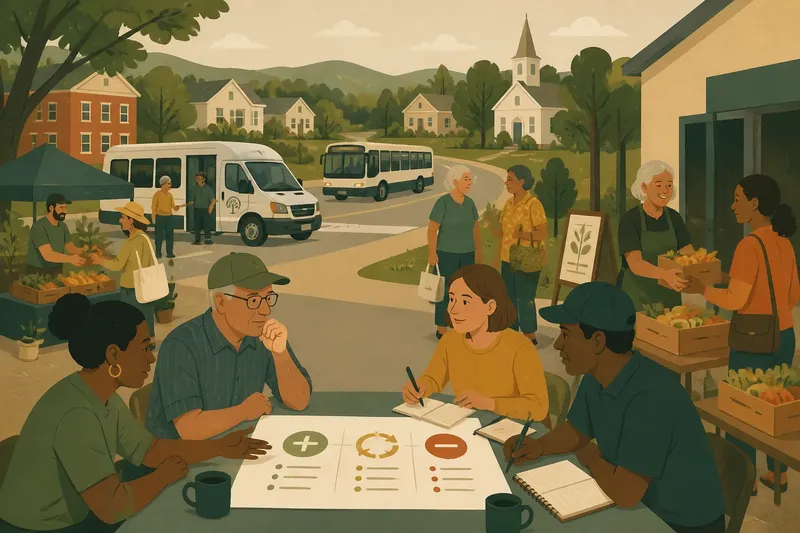
Regional Identity: One Label or Many Local Stories?
Regional identity shapes what change becomes visible. Compare broad labels with local descriptions to see whose priorities a Southern future includes.

What disappears when you call a place “the South” instead of naming the town, county, or neighborhood? Regional identity can make shared concerns visible, but a broad label can also blur the differences that explain why change matters in one place and not another. The useful question is not which scale is correct. It is what each scale lets a reader notice.
One shared label
Imagine a fictional group preparing a public conversation about the future of a Southern river corridor. Its members include residents of a small town, a county seat, and a neighborhood near the river. In their first draft, they call the whole area “the South.” The phrase is familiar and inviting. It can connect people who live far apart and give the discussion a frame larger than any one local dispute.
That broad frame makes certain questions easier to ask. What do communities across the region want to preserve? How might residents shape decisions that affect more than one town? Which experiences are routinely left out of accounts of Southern life? A shared label can provide a starting point for these questions without requiring every participant to have the same story.
But the phrase alone does not explain the corridor. It says nothing about which residents live near the river, how people travel between towns, or where public decisions are made. A reader might hear “the South” and imagine a single culture, a uniform landscape, or a common set of priorities. Those impressions can crowd out the actual places under discussion.
The local descriptions
In the invented group’s next draft, members replace the regional label with a list: a riverfront neighborhood, a mill town, farms along the county road, and the county seat. Each description brings a different set of questions into view. The neighborhood name directs attention to daily access to the river. The county seat points toward public institutions. The farms suggest land use and the relationships between rural residents and nearby towns.
Specific language also exposes how a single place can contain conflicting interests. “The county” may sound like a shared unit, but its residents may experience a new road, public service, or environmental decision differently according to where they live and how they depend on the land. Naming places does not settle those disagreements. It gives readers a clearer sense of where they arise.
There is a limit to local detail, too. A long inventory of communities can become hard to follow, and a description centered on one neighborhood may fail to show connections beyond it. If the river crosses several jurisdictions, a purely local account may make the corridor’s shared conditions difficult to see. Locality is not automatically more truthful; it is a scale with its own blind spots.
Changing the scale
For the group’s final draft, members keep the regional frame but attach it to specific places: “Southern river communities, including the riverfront neighborhood, the mill town, farms along the county road, and the county seat.” The wording does two things at once. It gives readers a larger connection to consider, then names the locations that make the connection concrete.
That edit changes what the conversation can hold. Residents can consider what the communities share without being asked to represent an entire region. They can also ask whether a proposed priority applies across the corridor or only in particular places. The larger label becomes a frame for comparison rather than a substitute for the places themselves.
Say a fictional neighborhood organizer is invited to describe a future for the corridor. If the prompt asks only what “the South” should become, she may struggle to connect her answer to the broad category. If it names the riverfront neighborhood and asks how its residents relate to the wider corridor, she has a more grounded entry point. The expected observable result is a description that identifies both a local concern and a connection beyond the neighborhood, without implying that she speaks for every Southern community.
Reading across levels
A reader can use scale as a way to examine a claim. When a statement describes a regional priority, ask which local places make that claim visible and which might complicate it. When a statement describes one neighborhood, ask what nearby connections it leaves outside the frame. These questions do not demand a complete map of every community. They help reveal what the chosen wording includes and excludes.
Pay attention to the nouns in a description. “Residents,” “rural communities,” “coastal towns,” and “the South” name different kinds of collectives, and none automatically identifies whose experience is being described. Adding a place name, such as a county or neighborhood, can make the scope more legible. Pairing it with a broader term can show how the local account relates to other places.
It is not worth forcing every discussion to name every locality. That can burden a short description without improving the reader’s understanding. Choose details that clarify the subject, and make clear when a regional phrase is a working frame rather than a claim that communities are interchangeable.
Questions of scale?
What does a regional label help readers see?
It can bring geographically separated places into one conversation and make shared concerns easier to compare. It works best when the account also names the places that give those concerns their particular form.
When should a description name a town or neighborhood?
Name a specific place when its conditions, institutions, or residents’ experiences matter to the point being made. A local name gives readers a clearer sense of whose circumstances the account describes.
Can one person speak for a region?
A person can offer an account grounded in a particular place, but that account should not be treated as a complete portrait of the region. Readers can consider it alongside other local descriptions rather than asking it to stand in for everyone.
A more useful frame
The fictional river group’s final wording does not resolve whose future should take priority. It does give readers a more accurate starting point: a regional connection made visible through named places. That is the practical value of choosing scale deliberately. The phrase “regional identity” becomes less like a fixed badge and more like a question about relationships—among communities, between local choices and shared conditions, and across stories that may not agree.
When you encounter a broad description of the South, look for the places it gathers together and the ones it leaves unnamed. When you read a local account, notice what wider connections it invites you to consider. Regional identity is clearest not when one label replaces many stories, but when the label helps readers see how those stories meet without mistaking them for one.