The Listening Session That Starts with a Better Prompt
A listening session with a neutral prompt helps Southern communities surface local priorities, preserve disagreement, and identify what decision-makers need to hear next.
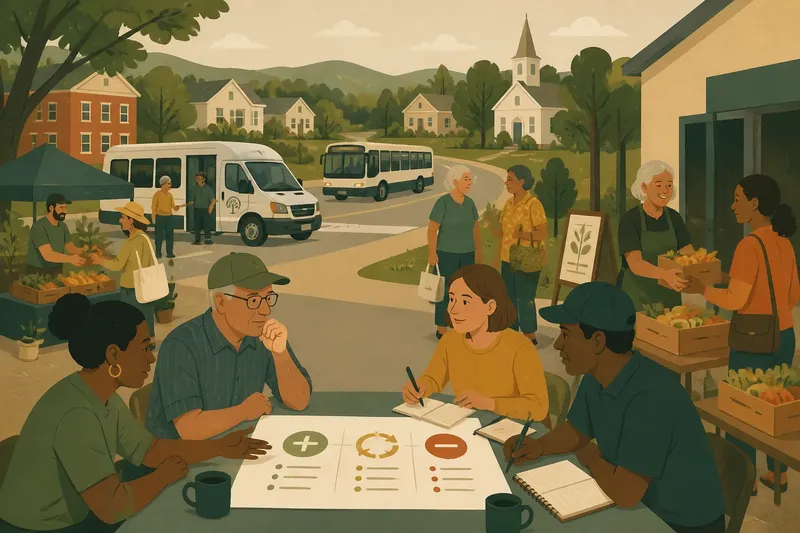
What can a listening session contribute when neighbors disagree about what their town should become? A listening session prompt can help people describe the changes they notice and the places, routines, and relationships they want regional decisions to respect. Across the South, where a county seat, a rural crossroads, and a fast-growing edge of town may face different pressures, the prompt should make room for local knowledge without pretending one gathering speaks for everyone.
The useful work is not simply collecting opinions. It is tracing how proposed changes connect to everyday life, public responsibilities, and the limits of local authority. A conversation can leave participants with a clearer account of what deserves attention—even when it cannot resolve a policy choice.
Questions before solutions
Choose a subject that residents can describe from experience, then ask about the change they notice and what it means. “What is changing in the places where people meet, work, or get help?” can open discussion of a clinic, a church, a school, a courthouse square, or a bus stop without steering the room toward a particular project.
Prompts that begin with “How do we bring…” often assume the remedy before participants have described the problem. Instead, ask what has become easier or harder, whose experience is missing, and what people would want a public decision-maker to understand before acting. The group can consider responses later, with observations and proposals kept distinct.
Do not try to fit the whole region into one question. If the concern is whether a county’s growth is serving people already living there, make that the subject. A separate conversation can address a different concern, such as access to public services in unincorporated communities.
Regional change in context
Southern communities are not interchangeable. A decision about a riverfront, a school, a highway corridor, or a downtown storefront can affect nearby residents differently from people who commute in, depend on the place for services, or have family ties there. Ask participants to name the scale they are discussing: a neighborhood, a town, a county, or a larger region.
That distinction can clarify which bodies have authority and who else should be part of the conversation. A town council may handle some local matters, while a county government, school board, regional planning body, or state agency may control others. If responsibility is uncertain, record the question rather than implying that the listening session can settle it.
Invite people to connect change to concrete civic choices: what should be protected, what needs attention, who bears the consequences, and what information is still missing. This keeps regional imagination grounded in decisions people can examine, rather than turning the discussion into a contest over which vision sounds most appealing.
Participation beyond regulars
A meeting room often draws people who already know how to enter public debate. That does not make their contributions less valuable, but it does mean organizers should not treat attendance as a measure of whose concerns matter. Invite through libraries, neighborhood groups, schools, faith communities, local service organizations, and direct contact with residents who seldom attend official meetings.
Explain the subject, purpose, and limits of the session in the invitation. Include practical details about the location, interpretation, translated materials, childcare, transportation, or remote participation when those options are available. A short, plain-language invitation is more useful than a formal notice that leaves people guessing about what will happen to their input.
Consider how the room itself affects participation. Small tables can make it easier to speak than a row of chairs facing a microphone. Quiet writing time, spoken contributions, and a way to share comments privately offer different routes into the discussion; none should be treated as the only legitimate form of participation.
Purpose and trust
At the outset, tell participants whether the session is gathering perspectives, advising a public body, or informing a later planning process. Be candid about who will receive the notes and what decisions remain outside the room. A listening session should not suggest that attendance gives participants control over a decision they do not actually hold.
Use a few plain working agreements: speak from what you know, leave room for others, question ideas without assigning motives, and respect requests to keep personal stories private. These agreements will not make disagreement disappear. They can help keep the discussion focused on the issue rather than on whether a speaker belongs in the room.
If a participant asks for a decision the group cannot make, answer directly and name the relevant public body or process if known. If that is not clear, say what needs to be checked and who will follow up. Honest uncertainty is more useful than an improvised promise.
Observations into priorities
Give people a moment to think before opening discussion. Ask them to note one change they have observed, one value or relationship they want decision-makers to consider, and one question they still have. Then invite contributions without requiring anyone to speak aloud.
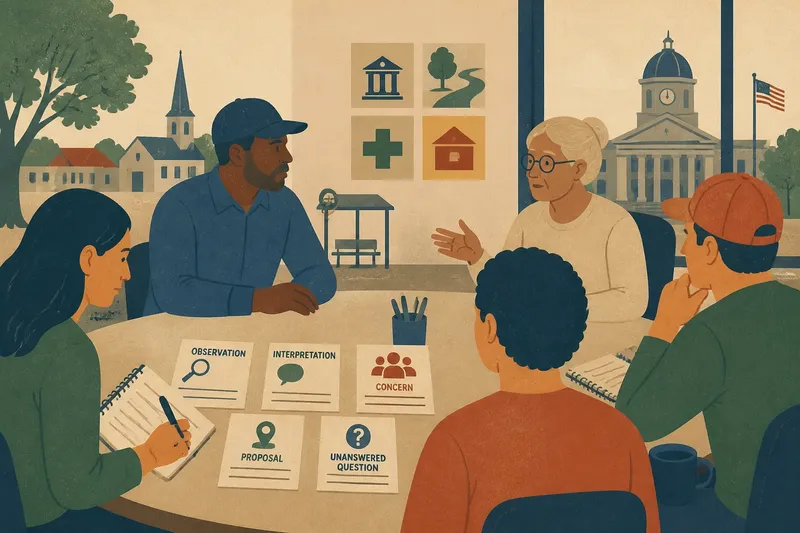
Record what people say in separate categories: observation, interpretation, concern, proposal, and unanswered question. A person’s report that a place has changed is different from an explanation of why it changed; both matter, but combining them too early can make an assumption look like an established fact.
Say you are convening residents to discuss what a small Southern town should consider as activity grows around its courthouse square. Imagine that one participant says the square still brings people together for errands, while another says the street crossing makes visits difficult for an older relative. The facilitator records each as a separate observation, asks what further information would help clarify access, and notes a possible crossing improvement as a proposal rather than a group decision. The resulting record identifies a shared place, a difference in experience, and a question for local officials without claiming consensus on a remedy.
When the group turns to priorities, ask which concerns affect different residents in different ways and which would benefit from more information. Do not force every issue into a single ranking. A shared concern can coexist with disagreement about its cause, urgency, or best response.
Records that keep differences
Summaries can flatten a conversation when they turn many views into a claim that “the community supports change.” Record the substance of agreement and disagreement, including concerns that were raised by fewer people. Do not imply that the comments represent all residents unless the process supports that claim.
Before circulating notes, remove personal details that are not needed and give participants a chance to correct how their contributions are represented. State who was invited, who took part, which groups or perspectives may be absent, and what the conversation did not address. If a public agency will receive the record, explain that clearly.
It is not worth the effort to polish every phrase into a tidy theme while discussion is still underway. Capture accurate notes first, then organize them carefully afterward. A clearly marked unresolved question is more trustworthy than a smooth summary that erases uncertainty.
Next questions for conveners?
How should a regional listening session define its boundaries?
Name the place and decision under discussion, then clarify which government or organization has authority. If a concern crosses town or county lines, record the connection and identify which additional communities or bodies may need to be involved.
What should organizers do when the prompt feels too narrow?
Ask participants which experience or group the wording leaves out, and revise it if the subject can remain clear. If widening the prompt would turn the session into several unrelated conversations, record the omitted issue and plan a separate discussion.
How can organizers distinguish shared priorities from consensus?
Record recurring concerns alongside differences about causes, trade-offs, and proposed responses. Describe a concern as shared only when the discussion supports that description, and avoid treating it as agreement on a specific policy.
What should happen after the session?
Send the notes in the form promised and explain where they will go next. If no formal decision process is attached, say so and identify a realistic next conversation or unanswered question rather than implying that a decision is pending.
A useful closing question
Close by asking what participants want decision-makers to understand and what question deserves attention next. Offer a written way to respond as well as a spoken closing round. That gives people a chance to clarify a point after hearing others and helps the facilitator catch misunderstandings before the notes circulate.
For a listening session about regional change, the last check is whether the record distinguishes what people observed, what they value, and what they propose. When those differences remain visible, officials and neighbors can use the conversation without mistaking it for a mandate or a complete account of the region.